

Boys’ clothing sizes in the UAE have inconsistent standards across brands, with European measurements in cm at one store and age-based sizing at another. Find size charts, common mistakes, and suggestions from here!
Table of Contents
“Which size should I buy when the age doesn’t match the fit?” This is a question I hear often, from moms and fellow aunties. As an aunt who frequently shops for her nephews, I’ve learned a lot through trial and error.
For today, I’ll start with my shopping blunder, and what I’ve learned about boys’ tshirt sizing in the UAE. I’ll also cover how different brands size their clothes, which measurements matter most, and some quick tips to find the right fit.
After reading, hopefully, you’ll shop with confidence whether you’re at Babyshop, Centrepoint, Zara, or ordering online.
My Eid Shopping Mess
Last Eid-ul-Adha, I thought I had the perfect surprise for my nephews, Ahmed (5) and Omar (7), who I visited in Dubai.
I found these adorable matching blue tshirt with camel designs, perfect for twinning photos! I carefully picked size 5 for Ahmed and size 7 for Omar, wrapped them beautifully, and couldn’t wait to see their excited faces.
After opening their gifts, they rushed to try them on. Ahmed’s size 5 top was tight around his chest and the sleeves barely reached his wrists! He tried so hard to put it on, but couldn’t even button it properly. Meanwhile, Omar had already torn off the packaging for his size 7 shirt. But when he put it on, it hung off his shoulders like a tent.
In desperation, I suggested Ahmed try on Omar’s size 7 top. Surprisingly, it fit Ahmed perfectly! But now Omar had nothing to wear and sat sadly in the corner.
My sister Fatima shook her head and laughed. “You should have asked me about the boys’ sizes in clothes! Ahmed has always been tall for his age, and Omar is still catching up on his growth spurt. The numbers on the clothing size tags don’t always match their ages.”
She was right. I had never thought about asking the measurements, assuming their ages and sizes would match perfectly. A simple mistake many of us make.
But let me explain.
Why Boys’ Clothing Sizes Are So Confusing in the UAE
So, last week I was shopping with my sister at the Dubai Mall, for her sons. We found ourselves completely puzzled in the children’s section. In one store, the size 6 shirt looked quite small, while in another, size 6 seemed fairly large!
I’ve noticed that in the UAE, we shop from a mix of different sizing systems. When I’m at ZARA or H&M, all the tags show heights like “116 cm” or “128 cm” instead of ages. Which I’d like to add, makes it easier to visualize and shop.
Then we go to Babyshop or Centrepoint, and suddenly everything is marked “6Y” or “7Y” based on age.
The same 6-year-old boy who wears “6Y” from Babyshop might need “116 cm” or even “122 cm” at ZARA. My nephew Ahmed needs completely different sizes depending on where we shop!
European brands like ZARA definitely make their clothes slimmer and more fitted. For active boys like Ahmed and Omar, who love to run and play, we always choose one size up at these stores to make sure they have room to grow and move comfortably.
If your little one has a heavier build, European brands might feel too tight even in what should be the “right” size. Remember that tag size is just a number, and every brand has their own standards of what that number means!
Popular UAE Brands: How Boys’ T-shirt Sizes Differ
Shopping for my nephews can be so confusing! Each time I visit a different store, it feels like I’m learning a whole new sizing language.
ZARA Boys’ T-Shirt Size Chart:
ZARA looks amazing on kids but their sizing is totally different from what I expected! Although a Spanish brand, they follow European (EU) measurements — incorporating the height in centimeters instead of ages. When buying for Omar, I had to hunt for “128 cm” instead of “age 7” which took forever to find.
Their clothes are also cut much narrower in the shoulders and chest. My nephew, Ahmed, who loves his food and has a slightly rounder tummy, feels squished in his regular size at ZARA. We always buy one size bigger there, but the sleeves end up too long!
| Age Range | Size Code | Height (cm) | Chest (cm) | My Experience |
| 3-4 years | 04/XS | 104 | 56.5 | Perfect for slim builds |
| 5-6 years | 06/S | 116 | 59.5 | Ahmed needed this at age 5! |
| 7-8 years | 08/M | 128 | 64.5 | Too tight for broader shoulders |
| 9-10 years | L | 139 | 71 | Great for tall 8-year-olds |
Boys’ T-Shirt Sizing for GAP
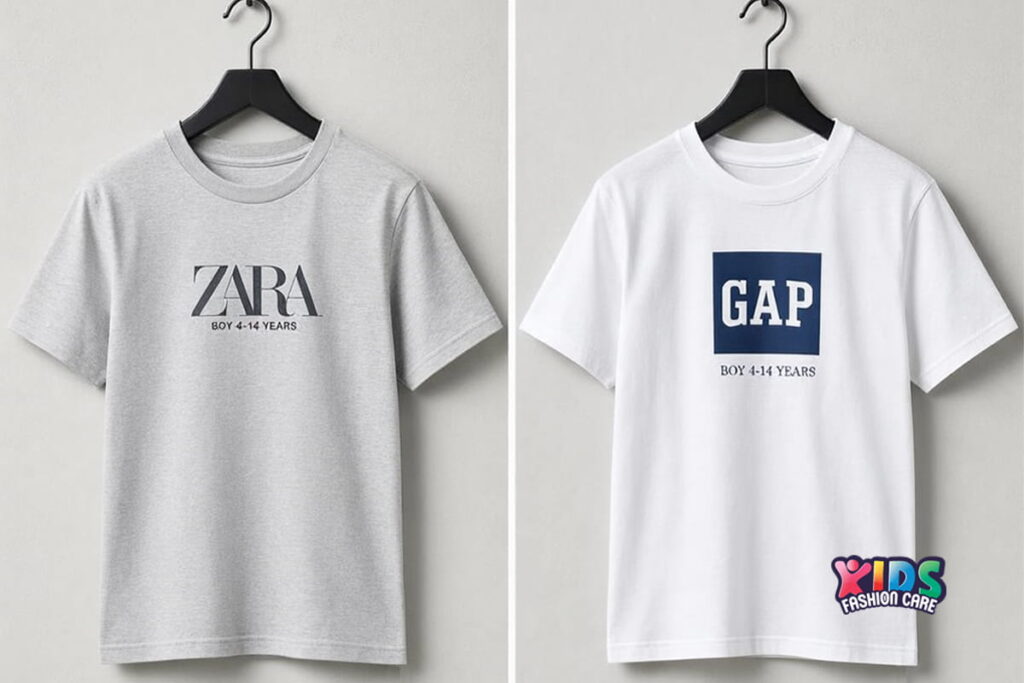
GAP is another brand we shop at often, and they use a totally different system! They stick to American sizing with S-M-L or age numbers like 6-7. What I’ve noticed is their clothes run much larger than the European brands.
A size 7 at GAP fits Ahmed perfectly, while he needs size 8 at ZARA! Their tops have more room in the chest and shoulders, which is great for active boys who need to move. My sister loves their t-shirts because they don’t shrink much after washing.
| Size Code (US/EU) | Size Code (UK/Japan) | Height (cm) | Weight (kg) | Chest (cm) | Sleeve Length (cm) |
| XS | 4-5Y/110cm | 99-114 | 15-22 | 58-61 | 47-51 |
| S | 6-7Y/120cm | 112-129 | 21-27 | 63-66 | 54-58 |
| M | 8-9Y/130cm | 129-137 | 27-32 | 68 | 62 |
| L | 10-11Y/140cm | 137-145 | 33-38 | 71 | 66 |
| XL | 12-13Y/150cm | 145-152 | 38-43 | 73 | 70 |
H&M Boys’ T-Shirt Size Chart
H&M falls somewhere in between. They use height measurements like ZARA but their clothes are cut a bit more generously.
They also have this “generous fit” option (marked with an “x”) that has been perfect for active play. My sister’s friend with twins says H&M is her favorite because one twin is taller and thinner while the other is shorter but sturdier – and H&M somehow works for both!
| Age Range | Size Code (EUR/AU) | Chest (cm) |
| 3-4 Years | 104cm/4 | 56.00 |
| 4-5 Years | 110cm/5 | 58.00 |
| 5-6 Years | 116cm/6 | 60.5 |
| 6-7 Years | 122cm/7 | 63 |
| 7-8 Years | 128cm/8 | 64-65 |
| 8-9 Years | 134cm/9 | 67.50-68.50 |
| 9-10 Years | 140cm/10 | 71.00-71.50 |
| 10-11 Years | 146cm/11 | 74.50 |
| 11-12 Years | 152cm/12 | 78 |
My sister has developed her own shopping strategy. For basic everyday shirts that need to survive playground adventures, she heads to Babyshop.
For special occasions when she wants the boys to look more polished, she checks ZARA (but buys one size up). When she’s unsure about the fit or needs something versatile, H&M is her safe middle ground.
The most important lesson? Don’t trust that the same size works everywhere! My shopping bag now always has a mix of “7Y,” “128 cm,” and sometimes even “8Y” tags – all for the same child!
Do Local UAE Brands Size Differently?
Sometimes my sister and I shop together at popular local brands like Babyshop, Centrepoint, and Splash Kids for my nephews’ clothes. We’ve noticed their sizing works quite differently from international brands, which can be both confusing and helpful when finding the right fit for Ahmed and Omar!
Babyshop’s “Juniors” collection seems specially designed for our climate and local children’s builds. The necks are wider and the fabrics are lighter – perfect for our weather! Although they use age-based sizes, there’s a twist. While they mark clothes with “5Y” or “7Y,” I’ve found these run about half a size larger than international brands. When Ahmed wears a 5Y in international brands, he fits perfectly in Babyshop’s 4Y or 5Y.
Centrepoint surprised me with their unique approach. Though they use age labels like “7Y,” they follow a different measurement standard. Their tops are consistently wider in the chest but shorter in length compared to Babyshop.
This was perfect when Omar went through that phase where he grew wider before getting taller! Their “Max” brand sizes also include half sizes like “6-7Y” which gives more flexibility between growth spurts.
Centrepoint Boys’ Tops Size Chart:
| Age (Years) | Size Label | Chest (cm) | Height (cm) |
| 3-4 | 4Y | 58-60 | 98-104 |
| 5-6 | 6Y | 61-63 | 110-116 |
| 7-8 | 8Y | 66-69 | 122-128 |
| 9-10 | 10Y | 70-72 | 134-140 |
| 11-12 | 12Y | 76-79 | 146-152 |
This official Centrepoint chart shows size 8Y should fit boys with a 66-69cm chest, but when Omar hit 67cm, the 8Y tops were still baggy on him. We discovered their ‘Max’ line runs about 2cm larger in the chest than their standard line, which isn’t reflected in this general chart.
Splash Kids takes yet another approach to sizing. While they use age numbers, they follow an older European standard that’s different from current ZARA or H&M measurements. Their clothes tend to run smaller in the shoulders but longer in the torso.
What’s really helpful is their clear labeling of “Regular,” “Slim,” and “Relaxed” fits right on the tag, so I know exactly what to expect. Their “7Y Regular” fits completely differently from their “7Y Slim.”
After so many shopping trips with my sister, I now just ignore the size labels completely! A “5Y” in one store might be perfect, while in another store we need “6Y” for the same child.
5 Common Boys’ Top Sizing Mistakes UAE Moms Make (And How to Avoid Them)
- Going by age alone:
My nephew Ahmed has always been tall for his age. Last birthday, I bought him tshirts with age 5 size tags that barely reached his belly button! Now I always check height measurements first. Age numbers on labels are just suggestions, especially for boys who grow at their own pace.
- Forgetting chest measurements:
This was my biggest shopping mistake when helping my sister! Omar’s shoulders and chest are broader than average, so even when I found tops with the right length for him, they would pull tight across his chest when he tried them on. My sister showed me how Omar couldn’t even raise his arms properly in those shirts!
Now we always check if he can do a quick ‘airplane arms’ test in the fitting room to make sure he can move around comfortably. That way, it’s a better fit for his adorable belly bulge too!
- Not checking where the brand comes from:
Spanish brands like ZARA run smaller and slimmer (based on EU sizing), compared to American brands like GAP. After buying those matching Eid shirts that didn’t fit, I learned to size up for European styles and stick to true size for American ones.
- Missing what other moms say in reviews:
One quick scan of online reviews can save so much hassle!

Last Ramadan, I almost bought Ahmed a “regular fit” shirt until I read three different moms commenting that it “runs extremely small” and “size up at least one size.” That five-second review check before leaving the house saved me a return trip to the mall!
- Using the same approach for all types of tops:
T-shirts can be a bit loose and still look fine, but formal shirts need to fit just right. My sister reminded me of this when I tried to apply my t-shirt shopping rules to buy Ahmed a dress shirt for his school concert.
- Ignoring fabric type when choosing size:
My sister made this mistake with several H&M shirts last season! She told me the 100% cotton shirts fit Ahmed perfectly in the store, but after one wash, they shrunk so much he couldn’t even get his arms through.
Now she always sizes up for pure cotton items and sticks to true size for polyester blends that hold their shape. When I help shop for the boys, I follow her experiences on fabric types.
Size Conversion Made Simple: US, UK and UAE Differences
When my sister or I shop for international brands online, this conversion chart always saves me the extra hassle:
| Age | US Size | EU Size (Height/cm) | UK Size | Chest (cm) |
| 4-5 | XS/4-5 | 110 | 4-5 | 57-60 |
| 6-7 | S/6-7 | 120 | 6-7 | 61-64 |
| 8-9 | M/8 | 130 | 8-9 | 66-71 |
| 10-11 | L/10 | 140 | 10-11 | 72-77 |
| 12-13 | XL/12 | 150 | 12-13 | 78-81 |
Shopping Pointer:
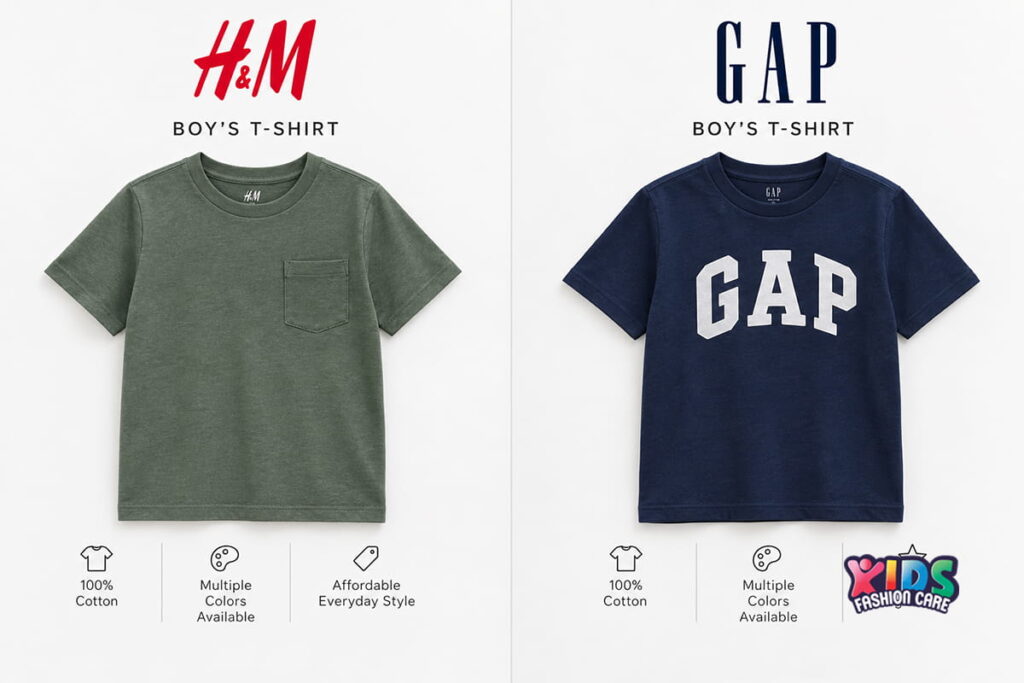
The biggest difference, according to many online reviews I’ve read, is that European sizes typically measure about 5-8 cm smaller in the chest compared to US sizes.
This explains why my sister found that her son’s American “Size 8” top from her online shopping would probably need to be a “Size 9” or “Size 130-134” when buying from European brands here in the UAE.
There could be slight differences in fabric preferences for different brands. Knowing which fabric works best for your kid is the easiest way out to purchase without a worry!
Growth Spurts and Wardrobe Transitions: What to Do when Boys’ Size Changes
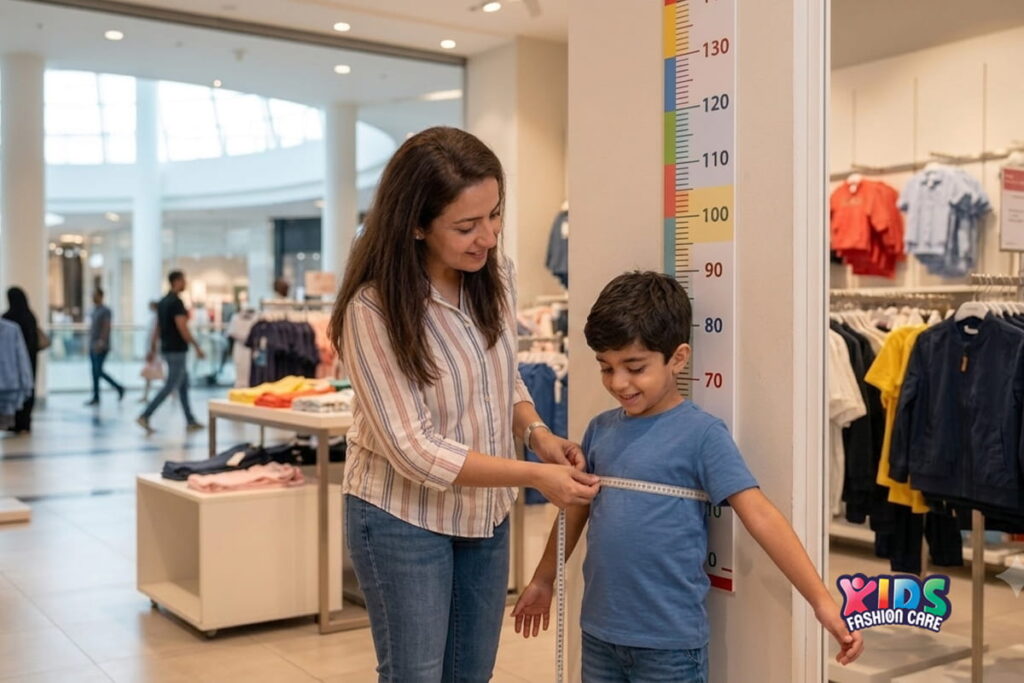
When my sister noticed Ahmed outgrowing his clothes almost monthly during his growth spurt from age 7 to 8, she started looking for early signs: shorter sleeve lengths, tighter chest fit, and Ahmed’s own complaints about comfort. These signals typically appear 2-3 months before a complete size change is needed.
Keeping simple chest and height measurements in her phone helps my sister track growth patterns and anticipate when to transition sizes.
For managing the wardrobe transition period, my sister has developed a practical system.
She buys a few “bridge pieces” in the next size that work well layered over existing clothes – like slightly oversized button-ups that work as light jackets before becoming proper shirts. This stretches the wardrobe during those awkward in-between months.
When uncertain between sizes during these transition phases, ordering both and returning the unwanted one saves time and frustration. Most UAE online stores offer free and easy returns now, making this approach practical. This method worked well for their special occasion outfits last Eid.
My sister has become quite strategic about sizing transitions. She’s started asking me to join her on shopping trips since I can sometimes spot good transition pieces. Though I’m definitely still learning about children’s sizing, I enjoy helping find flexible options that will last through my nephews’ next growth phases.
Frequently Asked Questions (FAQs)
What’s the most important measurement to take before shopping for boys’ tops in the UAE?
Chest measurement is crucial! While height helps determine length, a top that’s too tight across the chest will be uncomfortable regardless of age or height. Always measure the widest part of your child’s chest and compare it to the brand’s size chart.
Do European and American brands really size differently in UAE stores?
Yes! European brands (like ZARA and H&M) typically run 5-8cm smaller in chest width than American brands (like GAP). For European brands, size up at least one size, especially for active boys who need room to move.
How can I tell when my boy needs to move up a size?
Look for three early warning signs: sleeves that no longer reach the wrists, shirts riding up when arms are raised, and complaints about tightness in the chest or shoulders. These usually appear 2-3 months before a complete size change is needed.
Which UAE stores offer the most generous fit for broader or stockier boys?
Babyshop’s “Juniors” collection and Centrepoint’s “Max” line are consistently more generous in the chest and shoulders than European brands. For international options, GAP provides more room than ZARA or H&M for the same age range.
To Wrap It Up
Instead of worrying too much about the size guides, follow the basics: chest measurements, length, and its fit. After all, the notes app with your kids’ current sizing is only always a few taps away!